

Diese Website benutzt Cookies, die für den technischen Betrieb der Website erforderlich sind und stets gesetzt werden. Andere Cookies, die den Komfort bei Benutzung dieser Website erhöhen, der Direktwerbung dienen oder die Interaktion mit anderen Websites und sozialen Netzwerken vereinfachen sollen, werden nur mit Ihrer Zustimmung gesetzt.
ABLEHNEN Konfigurieren ALLE AKZEPTIEREN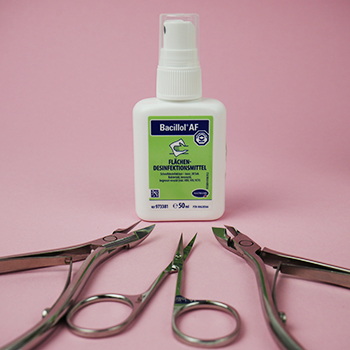 Every beginner and professional craftsman knows about the necessity of mandatory sanitary treatment of tools after each use. Such safety measures as sterilization, not only increase the quality of the services provided, but also protect both the master and the client from infection with infectious diseases.
In addition to safety, it is very important to take care of your tools properly. Processing of tools, according to sanitary rules, consists of the following main stages:
Let's consider each stage in more detail.
The disinfection stage is carried out immediately, as soon as the procedure is over. The craftsman must place all tools in the disinfection solution without pretreatment (do not rub, do not wash), immersing them completely in the container. So microorganisms will not have a chance to spread.
It is very important to choose the right liquid for processing tools, because they distinguish:
Ready-made solutions can be used immediately, taking the required amount of liquid, while concentrates require dilution with water. To work with concentrates, you will need special containers made of materials resistant to aggressive solutions. You can read how to use these or other means desinfectioncorrectly in the instructions or methods for use
For instrument disinfection we recommend using:
The last three liquids are designed for rapid disinfection without dilution with water. The maximum effectiveness of such disinfection is possible if the treated surfaces are completely wet.
The advantage of fast disinfection is the time of the procedure: the tools should be thoroughly wiped with a napkin soaked in the solution for 30-60 seconds. The disadvantage is the high cost of drugs.
At this stage, the instruments undergo cleaning before sterilization. . Such cleaning consists in washing and removing with the help of a stiff brush all visible traces of the use of the tool: skin remains, blood stains, dirt. In addition, the disinfectant, which has already completed its task, is washed off the surface of the tools. Cleaning should be done within 1 minute.
You can spped up the cleaning of tools with thr help of an ultrasonic cleaner. In addition to cleaning, this sink can simultaneously disinfect. Thus, it is possible not only to combine the two stages, but also to significantly reduce the time spent on disinfection and cleaning of instruments.
This important and final stage of processing allows to destroy absolutely all microorganisms on the surface of the tools. There are several types of sterilization:
Thermal sterilization can be carried out in an oven or in an autoclave. How do these sterilization methods differ? Read more about it.
Adrying cabinet is a sterilizer designed for processing dry instruments at high temperatures: the higher it is, the less time it will take to process the instruments. In dry heat, the tools do not come into contact with each other and with other hot surfaces (objects), which is an absolute advantage. You can load tools into the dry roaster in kraft bags or without them.
Drying cabinets are of different types and differ in the volume of the cabinet: you can choose a model for working with one set of instruments, or for simultaneous sterilization of 10 or more sets.
The autoclave involves sterilization under pressure at a temperature of 110-1350C. The procedure takes 10 to 15 minutes, depending on the program selected. Here you can sterilize tools in kraft bagsor simply by placing them on the shelves. Moreover, the tools can be loaded wet, and the rubber parts present on the tools will not deteriorate during the processing process.
Autoclaving is considered safe and non-harmful to instruments as they are not blunted. At the same time, this is an expensive option that involves the additional use of distilled water.
 This method of sterilization is also called cold sterilization, because it does not require high temperatures and special equipment. After the first two stages of processing, the tools are immersed in the prepared chemical solution. How to properly prepare the liquid is indicated in the instructions, compliance with which is a mandatory condition.
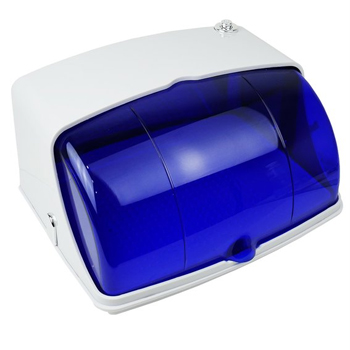
After curing the instruments should be rinsed with water and placed in a UV chamber or in kraft paper bags. Like pouches, UV sterilizers used to store sterile, clean, ready-to-use instruments.
We hope this information will help you follow important safety rules when working and storing tools. And, most importantly, do not forget to change and rotate means for disinfection and disinfection and sterilization of tools every six months, because bacteria and viruses are able to develop "immunity" to the same preparation.
WhatsApp
+48 45 956 69 09
 So verwenden Sie einen Aktionscode
Geben Sie den Aktionscode in das entsprechende Feld ein, bevor Sie Ihre Bestellung aufgeben.